
By Norma Jeanne Laurette
August 2026
Introduction
Artificial intelligence capabilities are advancing at an unprecedented pace, while robotics is moving from science fiction into everyday conversation and very soon, into our lives. This shift has been fuelled by predictions by Tesla CEO Elon Musk, who believes humanoid robots are soon to become one of the largest industries in history. According to Musk, Tesla plans to make its Optimus humanoid robots available for public purchase in 2027, potentially reaching around one million robots in operation by the end of 2027. He also states that there could eventually be tens of billions of humanoid robots worldwide, meaning more robots than humans (R1). There is growing agreement, that just like smart-phones, automated checkouts and voice assistants, robots will soon become highly utilized tools in our communities.
We will soon see robots working in public places, assisting in hospitals, delivering goods, maintaining buildings and performing tasks that are repetitive, dangerous or physically demanding. Eventually, robots are expected to enter homes to help with household chores, provide assistance for seniors and people with special needs and make daily life easier for everyone who can afford one. This raises the important question. How will a world with so many robots affect one of humanity’s oldest relationships, the one we have with our dogs?
The question is not whether robots will become part of our lives – it’s a matter of when. The real question is whether we’ll use them to strengthen the relationship with our dogs or slowly allow them to replace the very interactions that make that relationship so important, unique and extraordinary.
Dogs Need Real Relationships
Dogs don’t just need food, water, exercise and shelter – they also need relationships with their own kind and meaningful social, human interaction. Every walk we take together, every training session, every game of fetch, every cuddle on the couch, every gentle touch and every time we talk to our dogs, it strengthens our relationship – at least it does when we utilize benevolent leadership and positive training. These ordinary, everyday moments build trust, confidence, communication, a sense of security and emotional wellbeing. For more information about meeting your dogs’ emotional needs see my article entitled Emotional Fulfilment For Dogs.
If robots eventually become capable of feeding our dogs, throwing balls, opening doors, dispensing treats or even taking dogs for walks, we should ask ourselves one important question. Just because a robot can do something, should it?
Many of the daily activities involved in caring for our dogs are not simply chores, they’re opportunities to build and strengthen one of the closest and best relationships many people will ever have.
Rising Costs & Automation
Due to the corporate vet clinic takeover crisis among other factors, sharing our lives with dogs has become significantly more expensive in recent years. Veterinary costs have risen dramatically, with some analyses estimating increases of more than 40 percent between 2021 and 2026. Annual expenses for many dogs now exceed $4,000, while lifetime guardianship costs can easily surpass $50,000 depending on breed, health care requirements, size and longevity, in fact, one emergency can quickly eat up tens of thousands of dollars (R3). For more information about the affect corporate takeovers are having on vet fees see my article The Corporate Vet Clinic Takeover Crisis.
As robots become more affordable and capable, many families will be tempted to automate parts of dog guardianship to save time or money. Some people could decide against getting a dog altogether, some might choose breeds they believe require less work and expense, while others might rely more heavily on automated feeding systems, monitoring devices, robotic companions and AI training tools.
The Benefits Of Technology
Technology is not the enemy in fact many new products offer genuine benefits. AI-powered cameras can alert guardians if their dog appears anxious or distressed. Smart collars can monitor activity levels, sleep patterns, heart rate and location. Robotic devices can fill the food and water bowl, offer treats, monitor behaviour while guardians are away and even provide mental stimulation and enrichment through interactive games. Some robotic systems, such as ORo developed by Ogmen Robotics, can move throughout the home, interact with dogs, monitor behaviour and provide guardians with updates while they’re away (R4).
Robotic companion animals are already being used in hospitals, schools, nursing homes and care facilities across many countries, including Japan, the US, UK, Australia and other European countries. Research involving older adults with dementia and children with autism suggests that robotic animals can provide comfort, reduce loneliness and encourage interaction in situations where live
animals are impractical. However, when researchers compare robotic animals with real dogs, live dogs consistently produce stronger emotional responses, deeper social interaction and greater improvements in emotional wellbeing. This proves that although robots can complement conventional therapy, they cannot replace the unique benefits of interacting with live dogs (R7). Although these technologies can improve safety and convenience, they should always be viewed as tools, and never replacements for human care or companionship.
The Human/Canine Bond
Dogs are unique in that they’ve evolved to communicate with people in ways no other species can. Research has shown that dogs understand and respond to human gestures, make eye contact, recognize our emotions through sight and scent, respond to our voices and even synchronize some of their behaviour to mimic our own (R2). Training isn’t just about teaching cues and signals, it opens the lines of communication in both directions. Walking isn’t simply exercise, it’s quality time and shared exploration. Playing fetch isn’t simply burning energy, it’s social interaction. Even sitting quietly together strengthens the human/canine trust bond and attachment. For more information about a dog’s ability to read our emotions through scent see my article Canine Senses & Cognition. For more information about canine communication and body language see our first book Blueprint To A Happy Dog as well as my articles entitled Micro-Expressions In Dogs and Misunderstood Canine Communication & Body Language.
If robots begin performing many of these daily interactions, we risk losing countless opportunities to strengthen the relationship that matters so much. Regardless of how advanced it becomes, no machine can replace genuine human touch, affection, empathy or the satisfaction dogs experience when interacting with the people they love. For more information about meeting a dog’s emotional needs see my article Emotional Fulfillment For Dogs.
Preparing Dogs For Robots
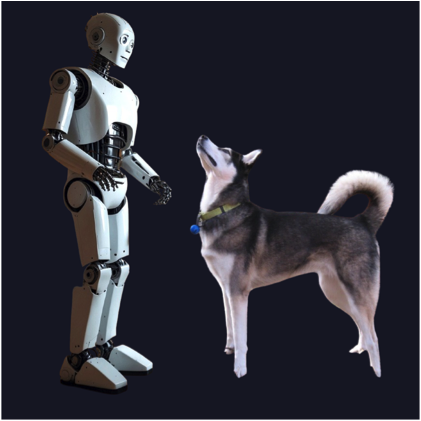
One area many have yet to consider is how dogs themselves will react to meeting robots for the first time or having them in their homes. To us, a household robot may seem intriguing but to a dog, it’s something different altogether. Robots can perform movements unlike any person or animal. They can move and change direction unpredictably, glide silently across the floor, suddenly change direction, make unfamiliar noises and some have flashing lights. They also lack the normal scent and body language dogs rely on to interpret emotions and social situations. Some dogs may quickly accept robots while many will become frightened, bark excessively, growl, attempt to escape or even chase or attack them. Because of this, many dogs will require careful behavioural preparation before robots can become part of their everyday life.
Desensitization & Counter-Conditioning
As robots become more common in homes, veterinary clinics, shopping centres, airports, hospitals and public spaces, professional dog trainers will play an increasingly important role in helping dogs become comfortable around them through desensitization and counter-conditioning. This process should never involve flooding, which means forcing a frightened dog to remain in close proximity or a confined area with a robot in the hope that it will eventually
become accustomed to it. Instead, we should rely on two well-established, scientifically supported behaviour modification techniques – desensitization and counter-conditioning. For more information about flooding, desensitization and counter conditioning, see our first book Blueprint To A Happy Dog.
Desensitization
Throughout the process, it’s important to keep the dog below threshold, which is the point at which fear or reactivity begins to occur. Desensitization involves introducing the robot gradually, beginning at a distance where the dog notices it but does not react. The robot should initially remain quiet and stationary before gradually progressing to slow movements, flashing lights and sounds. Each element is then increased slowly over time, as the dog remains relaxed, before gradually decreasing the distance, until the dog can comfortably tolerate normal operation with confidence.
Counter Conditioning
Counter conditioning changes the dog’s emotional response by pairing the robot with something the dog loves, such as favourite treats or toys, games, praise or other enjoyable experiences. Over time, the appearance of the robot predicts good things instead of something frightening, resulting in a dog that’s happy to see the robot (R5).
These methods have decades of scientific support and are considered the gold standard for helping dogs overcome fear and develop positive emotional associations (R5). Guardians who simply switch on a robot and expect their dog to figure it out are likely to unintentionally cause unnecessary stress, anxiety and fear, as well as a myriad of behaviour and possibly aggression problems. Teaching guardians how to guide their dogs as they adjust to robots will become another important responsibility for positive dog trainers. For more information about desensitization and counter conditioning see my article Stress & Anxiety In Dogs.
Positive Dog Training Techniques For Robots
In a full-circle moment, researchers have begun adapting techniques from professional positive dog training to teach robots new behaviours. Positive reinforcement, shaping, luring, verbal cues, hand signals and reward-based learning are now being used to teach quadruped robots how to navigate environments, interact with people and learn new behaviours more efficiently (R6).
Our Future
The technology itself isn’t something to fear, it’s the bigger concern that the convenience could slowly replace connection at the expense of our own and our dogs emotional wellbeing. Every responsibility we hand over to a robot is an interaction we no longer share with our dogs. When enough of those moments disappear, the relationship itself will begin to change, and it’s our responsibility to make sure it doesn’t. I for one will never allow a robot to care for or walk my dogs any more than I’d let most humans, but that’s just me. The way I see it, not only is it my responsibility to keep my dogs safe and meet all their needs, it’s a joy and privilege to do so.
Our Choice
If Elon Musk’s prediction is correct and robots eventually outnumber people, our homes and communities will soon look very different than they do today, but one thing that should never change is our connection and relationship with our dogs (R1). Technology should enhance our lives, not replace the moments that matter most. Every walk, training session, game of fetch, grooming session, cuddle on the couch and every quiet moment we spend together is invaluable and irreplaceable. Research has proven that these positive interactions increase oxytocin the (bonding hormone) in both dogs and people, helping to build trust, attachment and emotional wellbeing (R8). That bond is one of the greatest gifts dogs have ever given us and it’s up to us to make sure we never allow technology to take it away.
Summary
As remarkable as artificial intelligence and robotics may become, there is one thing they will never be able to replace, and that’s the relationship between dogs and the people who love them. Although there’s nothing wrong with using technology to make life a little easier, no robot, no matter how intelligent or sophisticated can love our dogs. It cannot celebrate your dog’s successes, comfort them when they’re frightened or experience the joy that comes from building a relationship based on mutual trust, respect and understanding.
As robots become part of our homes and daily lives, let’s use them wisely. Let them handle repetitive tasks so we have more time to do what only humans can do, which is build a lifetime of memories with those we love including our dogs. Technology should help us strengthen the human/canine bond – not replace it. If we move into this new era with our eyes open and good intent, we can all benefit from our future with robots.
References
(R1) Tesla. (2024). 2024 Annual Shareholder Meeting. Elon Musk discusses Optimus production plans and predicts that humanoid robots could eventually outnumber humans. Available from Tesla Investor Relations and shareholder meeting recordings.
(R2) Hare, B., & Tomasello, M. (2005). Human-like social skills in dogs? Trends in Cognitive Sciences, 9(9), 439–444.
(R3) American Pet Products Association. (2025). 2025–2026 APPA National Pet Guardians Survey. Veterinary inflation data from the U.S. Bureau of Labor Statistics Consumer Price Index.
(R4) Ogmen Robotics. ORo Companion Robot product information and technical specifications.
(R5) American Veterinary Society of Animal Behaviour (AVSAB). (2021). Humane Dog Training Position Statement.
Overall, K. L. (2013). Manual of Clinical Behavioural Medicine for Dogs and Cats. Elsevier.
(R6) Abdelghani, M., et al. (2024). Research describing how reward-based dog training techniques are being adapted to teach quadruped robots natural human interaction and navigation.
Noreils, F. R. (2024). Humanoid Robots at Work: Where Are We? arXiv:2404.04249.
(R7) Leng, M., et al. (2019). Use of Robotic Pets in Dementia Care: A Systematic Review.
Abbott, R., et al. (2019). The Therapeutic Effects of Human–Animal Interaction Compared with Robotic Animal Interaction: A Systematic Review.
(R8) Nagasawa, M., Mitsui, S., En, S., et al. (2015). Oxytocin-gaze positive loop and the coevolution of human-dog bonds. Science, 348(6232), 333–336.